

Why Businesses Are Switching to Performance-Based Marketing Strategies
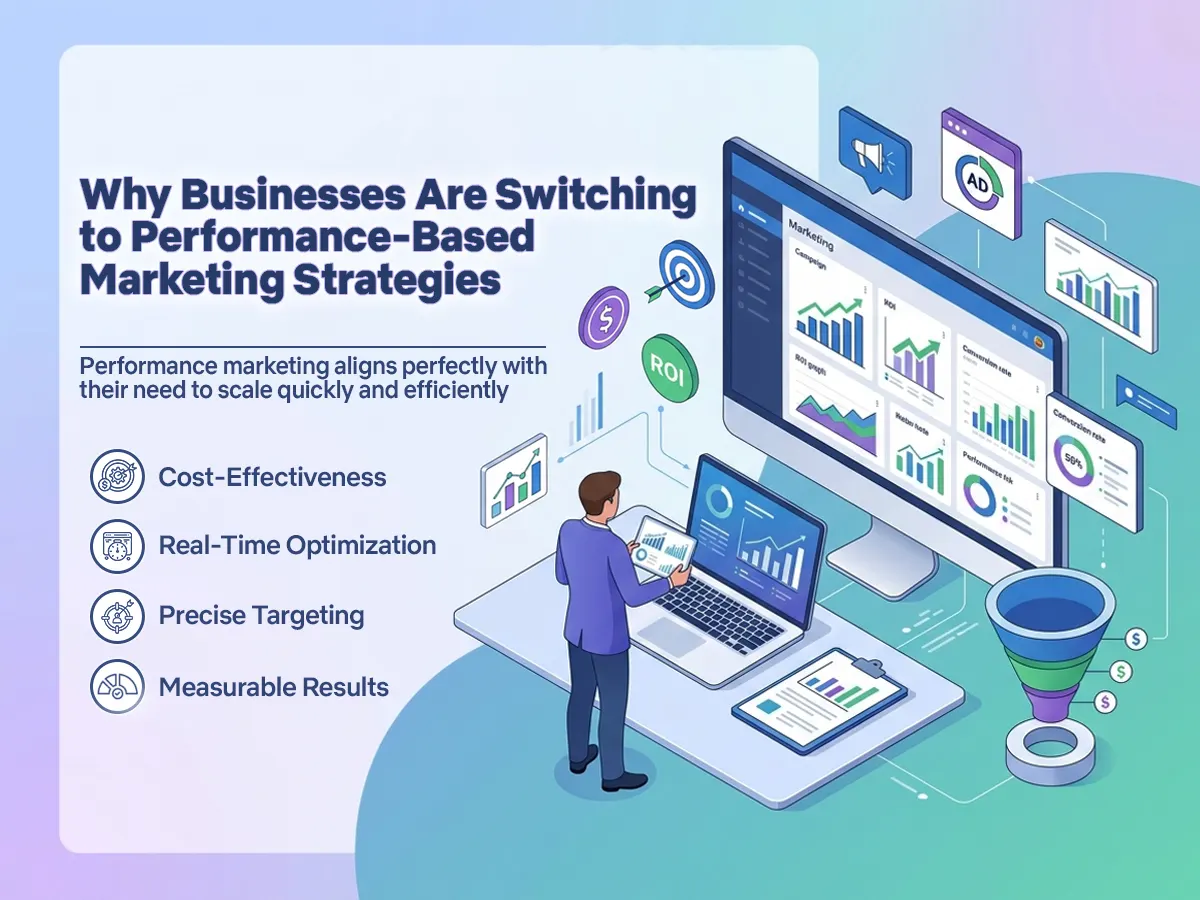
Why Businesses Are Switching to Performance-Based Marketing Strategies
Marketing budgets used to be an act of faith. You'd book a billboard, run a print ad, or sponsor an event and hope it worked. Today, that kind of faith-based spending is losing ground fast — because businesses can now pay for outcomes instead of exposure. That single shift, from "pay to be seen" to "pay when it works", is the real story behind the rise of performance-based marketing.
This guide breaks down what performance-based marketing actually is, why companies of every size are moving their budgets toward it, how it compares to traditional advertising, and how to build a strategy that turns marketing from a cost centre into a measurable growth engine.
What Is Performance-Based Marketing?
Performance-based marketing is a strategy where businesses pay for specific, measurable actions — clicks, leads, sign-ups, or sales — rather than paying upfront for ad space or impressions. It ties marketing spend directly to results, using channels like PPC, affiliate marketing, and paid social to track ROI in real time.
Unlike traditional brand advertising, which optimises for reach and recall, performance marketing optimises for a defined action. Every rupee or dollar spent is tagged to a result: a form filled out, a cart checked out, or a lead captured. This makes performance marketing a subset of digital marketing built around accountability rather than visibility alone.
Common channels include:
- Pay-per-click (PPC) advertising on Google Ads and Bing Ads
- Paid social media advertising on Meta, LinkedIn, and Instagram
- Affiliate and partner marketing
- Influencer marketing with performance-based commissions
- Retargeting and remarketing campaigns
- Programmatic and native advertising with conversion tracking
Performance Marketing vs. Traditional Marketing
|
Factor |
Traditional Marketing |
Performance-Based Marketing |
|
Payment model |
Pay upfront (impressions/space) |
Pay for results (clicks, leads, sales) |
|
Measurability |
Difficult to track ROI |
Real-time, granular tracking |
|
Risk |
Higher — spend regardless of outcome |
Lower — spend tied to performance |
|
Optimization speed |
Slow (campaign cycles) |
Fast (daily/weekly adjustments) |
|
Best for |
Brand awareness, long-term recall |
Lead generation, sales, conversions |
|
Reporting |
Broad reach metrics |
Conversion-level analytics |
Why Businesses Are Switching to Performance-Based Marketing
Businesses are switching to performance-based marketing because it offers measurable ROI, reduces wasted ad spend, allows real-time optimisation, and adapts to shrinking marketing budgets and rising customer acquisition costs. It gives leadership teams a direct line between marketing activity and revenue.
1. ROI Is Measurable Down to the Rupee
Finance teams no longer accept "brand lift" as a stand-alone justification for spend. With performance marketing, every campaign reports cost-per-click, cost-per-lead, and return on ad spend (ROAS) instantly. Businesses see, for every dollar invested in digital marketing overall, an average return of roughly five dollars, with SEO and email channels showing even sharper returns. That kind of clarity makes budget approvals easier and repeat investment automatic when a channel performs.
2. Budgets Are Under Pressure
Global ad spend is expected to cross the trillion-dollar mark in 2026, but that doesn't mean every business has unlimited room to experiment. Rising customer acquisition costs and tighter marketing headcounts mean every campaign has to justify itself. Performance-based models let a business start small, test fast, and scale only what's proven — instead of committing a full quarter's budget to a campaign that might not land.
3. AI Has Made Optimization Continuous
Modern performance marketing platforms use AI-driven bidding, audience targeting, and creative testing to adjust campaigns in near real time. Marketers are increasingly relying on automated systems to pace budgets and reallocate spend toward what's converting, which means underperforming ads get paused within hours, not months. This continuous feedback loop is something traditional, one-off advertising simply cannot replicate.
4. It Reduces Financial Risk
For small and mid-sized businesses especially, performance-based marketing lowers the barrier to entry. Instead of a large upfront media buy, a business can launch a campaign with a modest budget, evaluate performance, and only increase spend on channels delivering a positive return. This "pay for what works" structure is a major reason performance marketing has become the default approach for growth-stage companies.
5. Multi-Channel Attribution Is Finally Possible
With proper tracking (UTM parameters, pixel data, and CRM integration), businesses can see exactly which channel — search, social, affiliate, or email — contributed to a sale. This level of attribution helps marketing teams stop guessing and start allocating budget based on evidence, not assumption.
Real-World Examples of Performance-Based Marketing in Action
Real businesses use performance-based marketing to cut customer acquisition costs, scale profitable channels, and convert existing traffic more efficiently – from e-commerce brands running full-funnel paid media to SaaS companies pairing brand awareness with conversion campaigns to lower CAC
- E-commerce brands often combine full-funnel paid media across Google, Meta, and email into one measurement system and use conversion rate testing to keep customer acquisition cost declining over time rather than rising with scale.
- SaaS companies frequently blend brand-awareness campaigns with performance-driven search and social ads; some report a meaningful drop in customer acquisition cost after layering brand campaigns on top of pure performance ads over 6 months.
- D2C and retail brands use retargeting to bring back visitors who didn't convert the first time — a tactic that consistently performs because returning visitors convert at a much higher rate than first-time, cold traffic.
- Local service businesses (like agencies, clinics, and contractors) rely on PPC and local SEO campaigns where every lead can be traced back to a specific ad, keyword, or landing page.
How to Build a Performance-Based Marketing Strategy
Building a performance-based marketing strategy involves defining clear KPIs, choosing the right channels for your audience, setting up conversion tracking, testing creative and audiences continuously, and reallocating budget toward what's proven to convert – rather than spreading spend evenly across channels.
Step 1: Define What "Performance" Means for Your Business
Before spending a single dollar, decide what action counts as success — a purchase, a demo booking, a newsletter sign-up, or a qualified lead. Vague goals like "more visibility" don't translate into performance marketing; you need a measurable event.
Step 2: Set Up Conversion Tracking First
Install tracking pixels, UTM parameters, and CRM integrations before launching campaigns, not after. Without this, you cannot attribute results to the right channel, and you risk repeating the "spend and hope" pattern that performance marketing is meant to replace.
Step 3: Choose Channels Based on Audience Behavior
B2B audiences often respond better to LinkedIn and search ads, while B2C and e-commerce brands frequently see stronger returns from Meta, Instagram, and Google Shopping. A digital marketing services partner can help match channel selection to where your specific audience already spends time.
Step 4: Test, Measure, and Reallocate
Run small-budget tests across multiple audiences and creatives. Monitor cost-per-click, cost-per-lead, and ROAS weekly, then shift budget toward the top performers. This is the core discipline that separates performance marketing from traditional advertising — nothing runs on autopilot.
Step 5: Balance Performance With Brand Building
Pure performance campaigns can plateau if there's no brand recognition behind them. Many growth teams now pair performance ads with light brand-awareness spend, which has been shown to reduce acquisition costs over time by making cold audiences more receptive to the eventual conversion ask.
Common Challenges of Performance-Based Marketing
The biggest challenges include overreliance on last-click attribution, ad fatigue from overtesting, rising acquisition costs on saturated platforms, and the risk of optimising for vanity metrics rather than real revenue outcomes. Businesses that succeed treat performance data as a starting point, not the final answer.
- Attribution gaps: Not every conversion happens on the last-clicked ad; multi-touch attribution models are needed for accuracy.
- Ad fatigue: Audiences see the same creative repeatedly, causing performance to decline — creative refresh cycles are essential.
- Rising CPCs: As more advertisers compete for the same keywords and audiences, cost-per-click and cost-per-lead can climb, squeezing margins.
- Dashboard vs. reality mismatch: Some campaigns look successful on impression and click metrics but fail to convert into real revenue, which is why tying every metric back to actual sales data matters more than surface-level engagement numbers.
Performance Marketing vs. Brand Marketing: Which Should You Prioritise?
Neither replaces the other — performance marketing drives short-term, measurable conversions, while brand marketing builds long-term recognition and trust that makes performance campaigns more efficient over time. Most successful businesses run both in parallel rather than choosing one exclusively.
|
Factor |
Performance Marketing |
Brand Marketing |
|
Time horizon |
Short-term (days to weeks) |
Long-term (months to years) |
|
Goal |
Conversions, leads, sales |
Awareness, trust, recall |
|
Measurement |
Direct (ROAS, CPL, CAC) |
Indirect (surveys, recall studies) |
|
Budget flexibility |
High — adjust weekly |
Lower — needs sustained investment |
|
Risk level |
Lower per-campaign risk |
Higher upfront investment |
How EEM Branding Approaches Performance-Based Marketing
At EEM Branding, a branding agency in Ahmedabad, performance marketing is treated as one part of a larger 360-degree branding system rather than an isolated tactic. Campaigns are built on data-driven audience targeting, conversion tracking, and creative testing, while staying connected to the brand strategy, website design, and storytelling that make performance ads convert in the first place. This combination of measurable performance and consistent brand identity is what helps growth-stage and established businesses lower acquisition costs while building long-term recognition — not just short-term clicks.
Key Takeaways
- Performance-based marketing ties spend directly to measurable outcomes like clicks, leads, and sales — reducing financial risk compared to traditional advertising.
- Businesses are switching because of measurable ROI, tighter budgets, AI-driven optimisation, and the ability to attribute results across channels.
- Real-world use cases span e-commerce, SaaS, D2C, and local service businesses, each using performance data differently based on their sales cycle.
- A strong strategy starts with clear KPIs, proper conversion tracking, channel selection based on audience behaviour, and continuous testing.
- The best long-term results come from balancing performance marketing with brand-building, not choosing one over the other.
FAQ:
What is performance-based marketing in simple terms?
Performance-based marketing is an advertising approach where businesses pay only for specific results — like clicks, leads, or sales — instead of paying upfront for ad space regardless of outcome.
How is performance marketing different from digital marketing?
Digital marketing is the broader category covering SEO, content, email, and social media; performance marketing is a subset focused specifically on paid campaigns measured by direct, trackable actions.
What are the main channels used in performance-based marketing?
The main channels include pay-per-click (PPC) advertising, paid social media ads, affiliate marketing, influencer partnerships with commission structures, and retargeting campaigns.
Why are businesses moving away from traditional advertising?
Businesses are moving away from traditional advertising because it's harder to measure ROI, requires large upfront spend, and doesn't allow real-time optimisation the way performance-based campaigns do.
Is performance-based marketing suitable for small businesses?
Yes, it's especially useful for small businesses because campaigns can start with modest budgets, get tested quickly, and scale only once a channel proves profitable.
What metrics matter most in performance marketing?
Key metrics include cost-per-click (CPC), cost-per-lead (CPL), conversion rate, customer acquisition cost (CAC), and return on ad spend (ROAS).
Does performance marketing replace brand marketing entirely?
No. Performance marketing drives short-term conversions, while brand marketing builds long-term trust and recognition; most successful strategies combine both.
How long does it take to see results from performance marketing?
Initial data, like clicks and CPC, is visible within days, but reliable conversion trends and ROAS benchmarks typically take a few weeks of testing and optimisation to stabilise.
What role does AI play in performance-based marketing?
AI is used for automated bidding, real-time audience targeting, creative testing, and budget reallocation, allowing campaigns to optimise continuously rather than waiting for manual review.
What is customer acquisition cost (CAC), and why does it matter?
CAC is the total cost of acquiring one paying customer, including ad spend and related costs; it matters because it shows whether a marketing channel is profitable relative to customer lifetime value.
Can performance-based marketing work for B2B companies?
Yes, especially through LinkedIn ads, search campaigns, and gated content offers, where every lead can be tracked back to a specific channel and campaign.
What is the biggest risk of relying only on performance marketing?
The biggest risk is over-optimising for short-term metrics like clicks while neglecting brand equity, which can make customer acquisition more expensive over time as audiences become less familiar with the brand.
How do businesses track ROI in performance marketing campaigns?
Businesses track ROI using conversion tracking pixels, UTM parameters, CRM integration, and analytics dashboards that connect ad spend directly to leads or sales.
Should a business hire an agency for performance marketing?
An agency can help with campaign setup, audience research, creative testing, and ongoing optimisation — particularly valuable for businesses without an in-house team experienced in multi-channel attribution and paid media strategy.
What industries benefit most from performance-based marketing?
Ecommerce, SaaS, D2C consumer brands, and local service businesses benefit significantly because their sales cycles and conversion actions are easy to define and track.
Conclusion
Performance-based marketing isn't a passing trend — it's a response to a simple business reality: leadership teams want to know exactly what their marketing spend is producing. As budgets tighten and customer acquisition costs rise, the ability to pay for outcomes rather than exposure gives businesses more control, faster feedback, and lower financial risk. The businesses winning right now aren't necessarily spending more; they're spending smarter, with every campaign tied to a measurable result.
If you're ready to move your marketing budget from guesswork to measurable growth, talk to EEM Branding's team about building a performance-based marketing strategy tailored to your business.
About the Author
The EEM Branding Team is a branding and digital marketing agency based in Ahmedabad with 12+ years of experience helping businesses across industrial manufacturing, wellness, FMCG, and lifestyle sectors build measurable, growth-driven marketing systems. The team combines brand strategy, creative design, and performance marketing to turn campaigns into long-term business results. Learn more on the EEM Branding blog or explore digital marketing services.